
Early Intervention vs. Advice to Pay: Which Approach Is Right for Your Organization?
Organizations today are increasingly focused on supporting employee well-being while minimizing the operational and financial impacts of workplace absence. When an employee experiences an illness or injury that affects their ability to work, employers need a structured approach that supports recovery, facilitates accommodation, and promotes timely and sustainable return-to-work outcomes.
Two common approaches are Early Intervention (EI) and Advice to Pay (ATP) programs. Both are grounded in industry-leading disability management practices and emphasize early engagement, functional support, and proactive case management. The key difference lies in how income replacement is managed during an absence.
Understanding the advantages and considerations of each approach can help employers determine which model best supports their organizational objectives.

What is Early Intervention?
Early Intervention focuses on providing expert disability management and case management support at the earliest indication of an absence, health concern, or functional decline.
Under this model, employees typically access income replacement through existing workplace sick leave provisions, accrued sick banks, or Employment Insurance (EI) Sickness Benefits where applicable. The employer invests in proactive case management rather than funding a dedicated wage replacement program.
Early Intervention is best suited for organizations that want to:
Improve absence management practices
Strengthen stay-at-work and return-to-work outcomes
Meet accommodation obligations effectively
Reduce disability costs
Implement proactive disability management without adding a salary continuance benefit

What is Advice to Pay?
Advice to Pay combines proactive disability management with a structured employer-funded salary continuance program.
Similar to a traditional short-term disability benefits, eligible employees receive defined wage replacement during an approved absence. However, unlike many insurer-administered programs, the employer maintains control over policy design and decision-making while a third-party provides expert recommendations and case management support.
Advice to Pay is best suited for organizations that want to:
Offer short-term income replacement to employees
Improve the employee experience during medical leaves
Reduce reliance on insured short-term disability programs
Integrate salary continuance with proactive case management
Comparing the Two Approaches
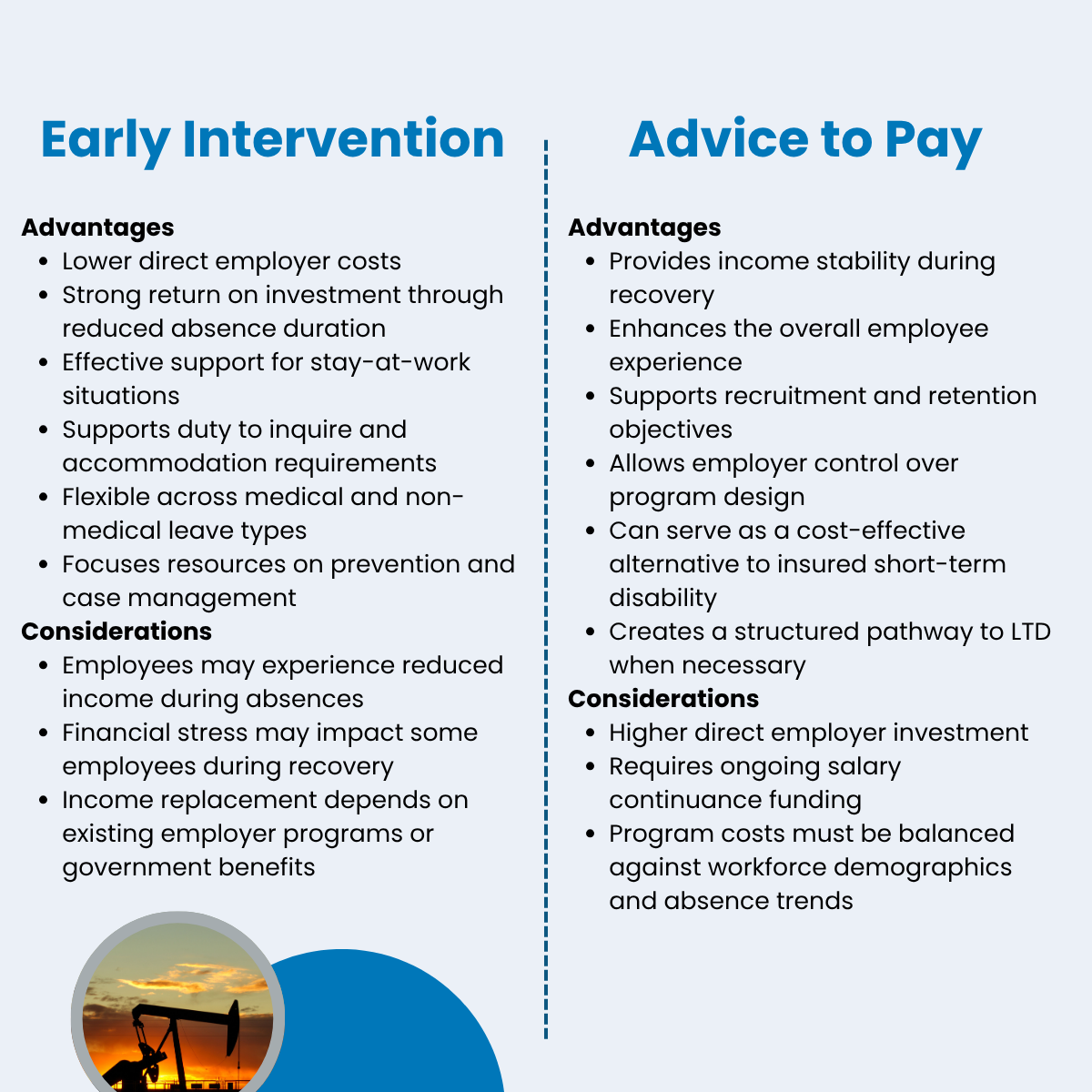
Which Model Delivers the Better Return on Investment?
The answer depends on what problem your organization is trying to solve.
If your primary objective is to improve absence management practices, reduce disability duration, and strengthen accommodation outcomes, Early Intervention often provides exceptional value with a relatively modest investment.
If your organization is also seeking to provide employees with income protection during periods of illness or injury, Advice to Pay may offer additional value by combining financial support with expert disability management.
Importantly, both approaches are most effective when supported by strong prevention, stay-at-work, accommodation, and return-to-work practices.
Final Thoughts
Whether an organization chooses Early Intervention or Advice to Pay, success depends on early action, functional-focused decision-making, and proactive case management.
At Integrated, our role is to help employers create practical, people-centered programs that reduce disability risk, improve employee outcomes, and support organizational performance. The right solution is the one that aligns with your workforce, budget, and long-term disability management strategy.